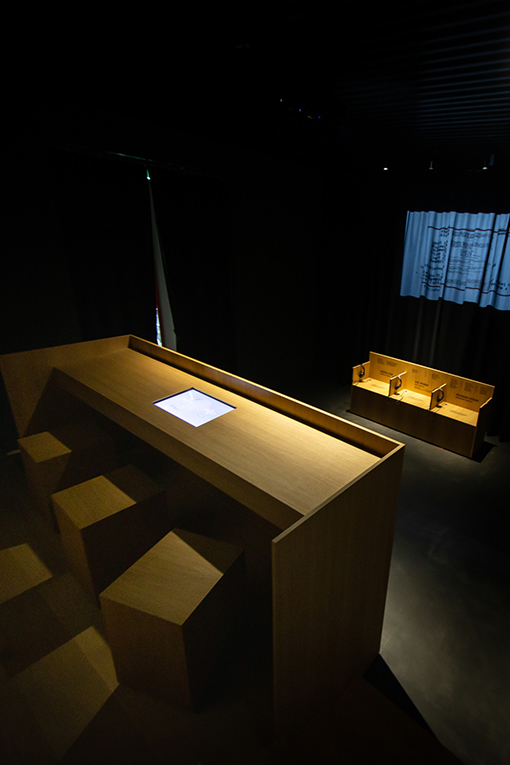
We have arrived in the darkened courtroom where the show trials took place. In the room, the elevated judge’s bench and the defendants’ dock stand facing each other.
There were no equal opponents here; everything took place according to a carefully written and precisely executed script.
Show Trials
The verdict against the defendants had already been decided before the trial began. Nevertheless, the proceedings were staged while maintaining the appearance of legal procedure. Everyone had their assigned role, their rehearsed lines, and the outcome was already known in advance. The six-step “trial preparation” process was simple: the Party determined beforehand whom to accuse, what charges to bring, who would be the defendants, and who would serve as witnesses.
“Confessions”
Before the trial, the defendants were forced – by one means or another – to provide so-called “confessions”. Their interrogators from the State Protection Authority (ÁVH) made them rehearse every detail of the “performance”. From that point onward, the defence lawyers had only a formal role during the proceedings. In the end, all that remained was to act out the entire scenario and announce the predetermined verdict.
Iconic Trials
Three major groups of show trials are presented here. These cases became iconic not only because of the individuals who stood accused, but also because they continued even during periods considered more “peaceful”.
The first was the main trial against Archbishop József Grősz of Kalocsa and his associates, known as the Grősz Trial, which took place between 15 June and 20 July 1951.
The second emblematic group consisted of the Regnum Trials, held in 1961, 1965, and 1971/1972. The first Regnum Trial took place as part of the so-called Black Ravens investigation. This operation targeted former Cistercian and Jesuit communities, the KIOE [National Association of Catholic Craftsmen and Working Youth], the KLOSZ [National Association of Catholic Girls], Regnum Marianum and other youth organizations, certain members of the Piarist and Benedictine orders, as well as communities and groups led by individual priests.
The third group of trials is represented by the trials against KIE, the Christian Youth Association, which took place in 1951 and 1967. In this exhibition space, visitors can experience both perspectives: sitting in the defendants’ dock, they can hear excerpts from the recollections of three convicted individuals, including their moving accounts of events before and during the trials. From the elevated judge’s bench, they can explore the documentary material of the proceedings, complemented by projected presentations accompanying the interactive content.
You can experience both perspectives: sitting in the defendants’ dock, you can hear the convicted individuals’ memories and spoken accounts of what they experienced during the trials; from the judge’s bench, you can explore the documentary records of the proceedings.
Corridor: Drifting Away from the Church
In the corridor following the courtroom, visitors can follow, like turning the pages of a giant photo album, the contrasting scenes of state and religious education placed opposite one another. These images reveal both the aftermath of the discrediting campaigns against the churches and their long-term impact on society.
The church policies of the Rákosi and Kádár eras, and their approach toward religious communities and religious worldviews in general, achieved their intended effect. The carefully constructed image of a common enemy reshaped ordinary people’s attitudes toward faith, religion, and the churches. Trust was shaken, and persistent doubts spread through people’s minds, eventually leading to a gradual distancing from religion. This process was further intensified by the profound transformation and modernization of society, as well as by the rise of a scientific, materialist worldview that was often presented as incompatible with religious belief.
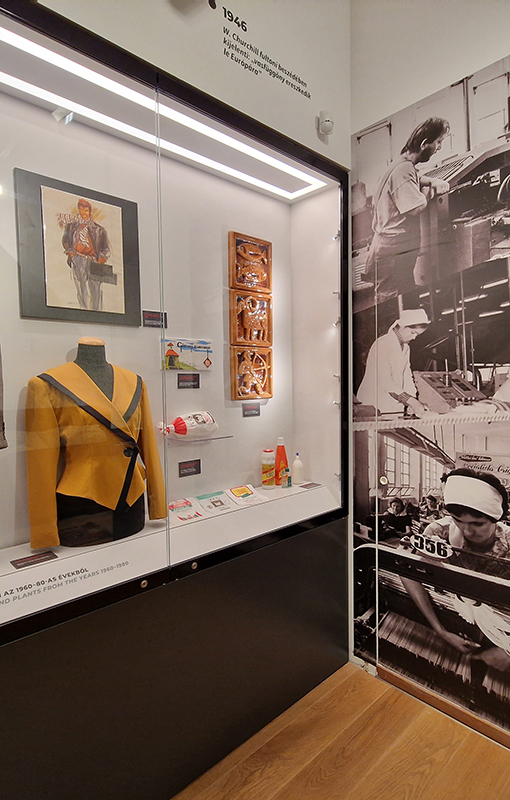
Religious education, church ceremonies, and traditional celebrations were first replaced and then transformed into state versions of the same rituals: civil ceremonies instead of church weddings, naming ceremonies instead of baptisms, and the “Pine Tree Celebration” instead of Christmas. Over the passing decades, this transition remained unnatural only for those in whom the power of faith had taken deep root and proved impossible to erase.

In the Giant Photo Album, you can discover how religious education and church ceremonies were replaced by their state-created versions, such as baptism-naming ceremonies and Christmas-Pine Tree Celebrations.